
Quick summary
A modern cloud phone system provides a small business with the communication features needed to meet customers’ expectations, which are much more than a dial tone. It gives the team a cleaner way to answer customers, work from different places, and manage calls without babysitting old equipment.
Key takeaways:
- A cloud-based phone system uses your existing internet connection rather than relying solely on physical copper phone lines.
- A cloud phone can work through desk phones, a desktop app, and mobile devices.
- The right phone system can help route calls, support video conferencing, add team messaging, and keep business calls organized.
- A cloud business phone system creates much-needed cost savings by reducing hardware, maintenance, and some calling costs.
- AI-powered tools are starting to help with post-call summaries, voicemail transcription, and simple customer intake, but this is only the beginning.
Why Small Businesses Are Moving Away from Traditional Phone Systems
It can be a double-edged sword sometimes when your business communication has been consistent. Consistency can be a trap that will lull you into thinking it will always be there, but with traditional phone systems, you need to reassess before they crash and burn.
The cracks will start to show when a traditional phone system can’t handle the scenarios you need it to, like properly routing customer calls after business hours. A technician can’t take office calls while on the road. A front desk employee is already on the line, and a caller is forced to hold. Then, someone leaves a voicemail, but nobody sees it until the next day. These daily speed bumps can really put a wrench in your operations.
One of the fatal flaws of traditional phone systems is that they are built around a building, a closet full of equipment, and the public switched telephone network. That worked when everyone sat near the same phones all day. But it’s much harder when teams are split between the office, the field, and home, while still needing to be available for customers.
Conversely, a cloud phone system is built for flexibility and uses a stable internet connection to handle voice calls, messaging, and call controls. That makes it easier to support desk phones in the office, a mobile app for staff on the road, and a desktop app for employees working from a computer.
Nored Telcom’s business voice solutions help companies choose the right setup, whether that means hosted VoIP solutions, hybrid support, or a full move to NTCloud.
What a Cloud Phone System Actually Does
A cloud phone system is a business phone setup hosted by a service provider instead of sitting entirely isolated on equipment in your office. It can handle inbound and outbound calls, voicemail-to-email, call forwarding, call queues, an auto attendant, call recording, and custom call routing.
The ace up many cloud phone systems’ sleeves is bringing several communication channels into one place. That includes team messaging and video conferencing. Then you can take it even further by connecting other business tools, such as CRMs or scheduling software, so your staff can see customer details while they talk.
Here’s an example of cloud communication when it’s fully implemented: a customer calls your business phone number, an auto attendant sends the call to the right team, the employee answers from a cell phone or desk phone, and the call notes can be tied back to business tools, without a second thought.
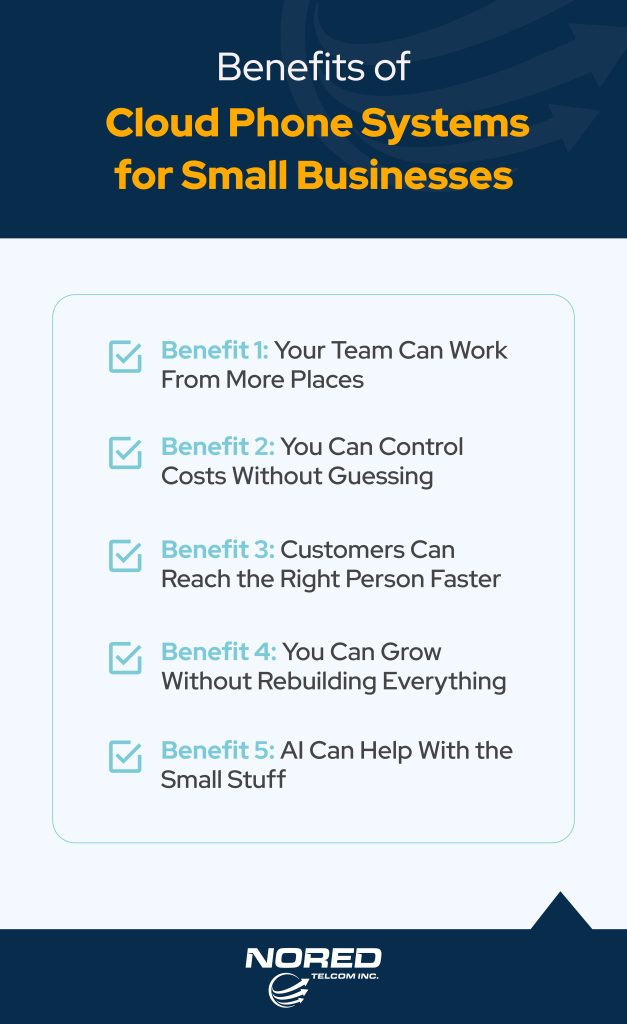
Benefit 1: Your Team Can Work From More Places
A cloud phone system for small businesses helps your team stay connected without handing out personal numbers or delaying returning a phone call for longer than you should because you can’t easily connect to the system.
A service manager can receive phone calls from a mobile app. A salesperson can make outbound calls from the same business phone number while traveling. Office staff can answer from desk phones or soft phones. Remote teams can use their own devices when needed, while still keeping calls tied to the company.
A cloud phone service doesn’t need to be flashy to be effective. The point is that your team can make and take calls from wherever work is happening, as long as they have a stable internet connection.
For a small business with field employees, remote workers, or multiple locations, that flexibility can save a lot of “who has the message?” confusion.
Benefit 2: You Can Control Costs Without Guessing
Cloud phone system cost depends on users, features, devices, and the provider. Hosted VoIP usually runs as a monthly service, and pricing can vary based on the number of users.
The biggest cost savings often come from what you no longer have to maintain. A cloud-based phone system can reduce the need for on-site servers, large upfront hardware purchases, and ongoing maintenance for physical equipment. A big source of cost savings comes from eliminating the need for traditional phone lines, since calls use the internet connection your business already has.
For East Tennessee businesses, local help matters. Nored Telcom can help compare VoIP needs, explain the real phone service costs, and recommend a setup that makes sense before you sign anything.
Benefit 3: Customers Can Reach the Right Person Faster
You’ll never find a customer who cares about how your phone system works. They only care whether someone helps them.
A cloud-based phone service helps to improve the customer experience with advanced call management. Features like call queues, unlimited ring groups, an auto attendant, call recording, voicemail transcription, and call forwarding help reduce missed calls and long waits.
| Business Need | Cloud Phone Feature That Helps |
| Busy front desk | Call queues and ring groups |
| After-hours calls | Auto attendant and call forwarding |
| Missed messages | Voicemail to email and voicemail transcription |
| Staff in the field | Mobile app and cloud phone access |
| Training and quality checks | Call recording and advanced reporting |
| Multiple locations | Multi-site management |
Benefit 4: You Can Grow Without Rebuilding Everything
Growth can make an old business phone system messy.
Maybe you need to add a second location. Maybe you hire two new employees and need to set up their accounts. Maybe high call volumes hit during a busy season. With older systems, even small changes can feel like a project because, in reality, they are.
A cloud phone system for small business is easier to adjust. Admins can add users, change call queues, set up toll-free numbers, update business hours, or add phone features without ripping apart the office.
That’s one reason business communications are moving toward the cloud. It’s easier to manage one phone system across several people, devices, and places.
Benefit 5: AI Can Help With the Small Stuff
AI shouldn’t make customers feel like they are stuck arguing with a brainy vending machine.
Used well, AI-powered communication tools can help with the small tasks that eat time. Think post-call summaries, basic intake, appointment requests, caller questions, and notes for follow-up. There can also be support for virtual receptionists or smarter routing, so inbound calls are handled faster.
To be clear, the point of AI is to provide customers with better, more complete information so they aren’t forced to call back.
For a law office, that may mean better intake notes. For a home service company, it may mean collecting job details after hours. For a medical or dental office, it may mean helping sort common questions before staff step in.
Get the Benefits Without the Guesswork
A cloud phone system will make your business easier to reach and easier to run.
Nored Telcom has helped businesses across East Tennessee move from outdated setups to hosted VoIP solutions they’ll happily use for years to come. We can help you compare options, keep what still works, and build a phone system that fits your people.
If your current phone system feels too rigid, too expensive, or too hard to manage, reach out to Nored Telcom to learn how a cloud phone system for small business can help your team stay connected.